Handouts

Topics: Caring for yourself and familyNew

Supporting your grandchildren and their parents

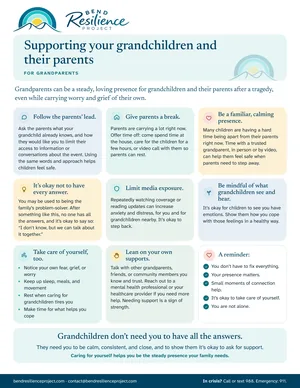
A one-page guide for grandparents on being a steady, loving presence for grandchildren and their parents after a tragedy, from following the parents' lead and giving them a break to limiting media exposure, taking care of yourself, and leaning on your own supports.

For: Grandparents
ViewDownload PDF(1.0 MB)En español(PDF, 230 KB)
Share: Supporting your grandchildren and their parents

Supporting your grandchildren and their parents

Download PDF
The pages of Supporting your grandchildren and their parents. Download the PDF to print it or read it as text.

Topics: Talking with your child · Understanding reactionsNew

Talking with student-athletes after a traumatic community event

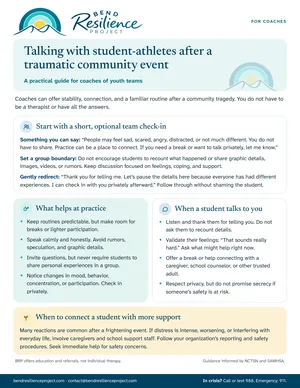
A one-page guide for coaches of youth teams after a community tragedy, with a short, optional team check-in, what helps at practice, what to do when a student talks to you, and when to connect a student with more support. Informed by guidance from the NCTSN and SAMHSA.

For: Coaches and teams

ViewDownload PDF(979 KB)En español(PDF, 216 KB)
Share: Talking with student-athletes after a traumatic community event

Talking with student-athletes after a traumatic community event

Download PDF
The pages of Talking with student-athletes after a traumatic community event. Download the PDF to print it or read it as text.

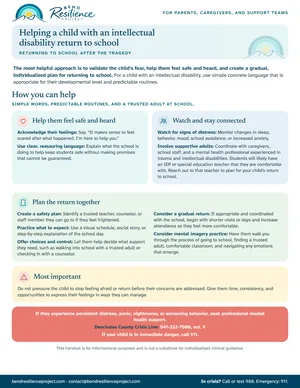
Topics: Going back to school · Children with extra needsNew

Helping a child with an intellectual disability return to school

A one-page guide for parents, caregivers, and support teams helping a child with an intellectual disability return to school after the tragedy, with simple language, predictable routines, and a trusted adult at school.

For: Parents and caregivers · Educators and schools

ViewDownload PDF(216 KB)En español(PDF, 217 KB)
Share: Helping a child with an intellectual disability return to school

Helping a child with an intellectual disability return to school

Download PDF
The pages of Helping a child with an intellectual disability return to school. Download the PDF to print it or read it as text.

Topics: Understanding reactions · Finding help

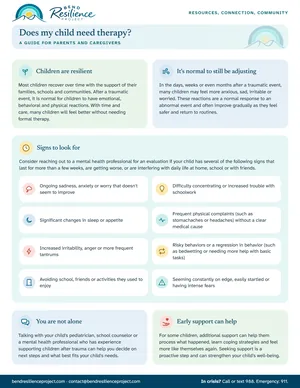
Does my child need therapy?

A one-page guide for parents and caregivers on how to tell whether a child's reactions after a traumatic event are part of normal adjustment or a sign to seek a mental health evaluation, with eight signs to watch for.

For: Parents and caregivers

Does my child need therapy?

Download PDF
The pages of Does my child need therapy?. Download the PDF to print it or read it as text.

Topics: Going back to school

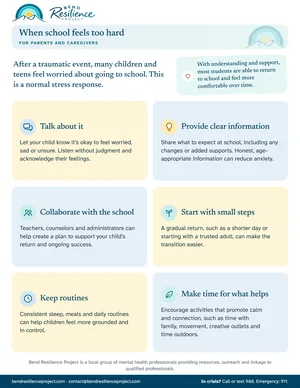
When school feels too hard

A one-page guide for parents and caregivers whose child is worried about going back to school after a traumatic event, with six ways to help: talking about it, clear information, working with the school, a gradual return, keeping routines, and making time for what helps.

For: Parents and caregivers · Educators and schools

When school feels too hard

Download PDF
The pages of When school feels too hard. Download the PDF to print it or read it as text.

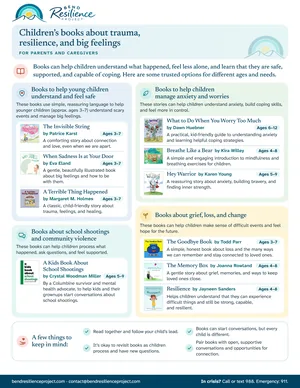
A one-page reading list for parents and caregivers, with ten children's books about scary events, worry, grief and resilience, the ages each suits, and a short note on each.

For: Parents and caregivers · Educators and schools

ViewDownload PDF(1.0 MB)En español(PDF, 1.0 MB)See the books
Share: Children's books about trauma, resilience, and big feelings

Children's books about trauma, resilience, and big feelings

Download PDF
The pages of Children's books about trauma, resilience, and big feelings. Download the PDF to print it or read it as text.

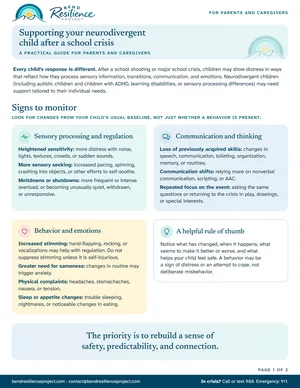
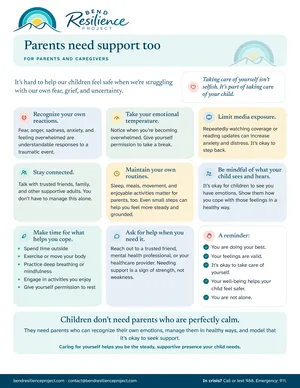
A two-page guide for parents and caregivers of autistic children and children with ADHD, learning disabilities, or sensory processing differences after a school crisis: the signs to watch for, ways to help, and when to seek professional support.

For: Parents and caregivers

ViewDownload PDF(301 KB)En español(PDF, 304 KB)
Share: Supporting your neurodivergent child after a school crisis

Supporting your neurodivergent child after a school crisis

Download PDF
The pages of Supporting your neurodivergent child after a school crisis. Download the PDF to print it or read it as text.

Topics: Understanding reactions

Supporting children after a traumatic event

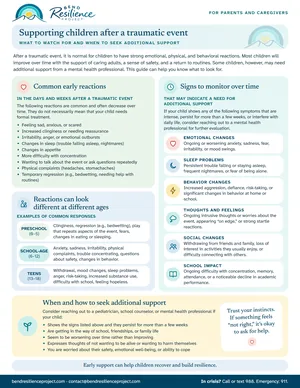
A one-page guide for parents and caregivers. It describes the reactions that are common in the days and weeks after a traumatic event, how they can look at different ages, the signs to watch for over time, and when to reach out for more support.

For: Parents and caregivers · Grandparents · Educators and schools

ViewDownload PDF(247 KB)En español(PDF, 248 KB)
Share: Supporting children after a traumatic event

Supporting children after a traumatic event

Download PDF
The pages of Supporting children after a traumatic event. Download the PDF to print it or read it as text.

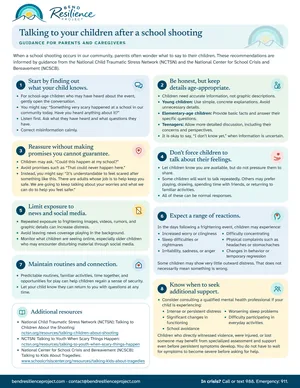
Eight steps for talking with children of any age after a school shooting, from finding out what your child already knows to knowing when to seek more support. Informed by guidance from the National Child Traumatic Stress Network and the National Center for School Crisis and Bereavement.

For: Parents and caregivers · Grandparents

ViewDownload PDF(255 KB)En español(PDF, 257 KB)
Share: Talking to your children after a school shooting

Talking to your children after a school shooting

Download PDF
The pages of Talking to your children after a school shooting. Download the PDF to print it or read it as text.

More from the Bend Resilience Project

Treatment

Evidence-based treatments for trauma

Learn about treatments for children, teens, and adults, and what each one involves.

See treatments

For groups

Free talks and trainings

Free talks and trainings for schools, teams, faith communities, and other groups.

Learn about free talks